


PEN Film for New Energy Battery and Electronic Components
Features
1. Higher continuous use temperature than PET(155–180℃ typical, vs. ~130°C for PET; short-term peaks up to 200℃+)
2. Excellent dimensional stability–Low coefficient of thermal expansion (CTE ~15–20 ppm/℃, about half that of PET), minimal heat shrinkage
3. Superior hydrolysis resistance–Outperforms PET in hot/humid environments; suitable for outdoor and underwater applications.
4. Good chemical resistance–Resists acids, alkalis, solvents better than PET
5. Outstanding electrical insulation–High dielectric strength, volume resistivity, and tracking resistance
6. Transparency options -- Optical-grade PEN achieves haze <2% and luminousness >85% (similar to Teijin Q65HA); industrial grades offer controlled translucency
7. Excellent barrier properties–Lower oxygen and moisture vapor transmission rates than PET
8. Good mechanical strength–High tensile modulus and tear resistance
| Product name |
High Temperature & Chemical Resistant PEN Film for New Energy Battery |
| Regular thickness |
25μm、50μm、75μm、100μm,125μm |
| Regular width |
1000mm |
| Length |
Customized as per request |
| Transmittance |
≥75% (up to ≥85% for certain types) |
| Haze |
≤3% |
| Temperature resistance |
155℃~180℃ |
Recommended Applications:
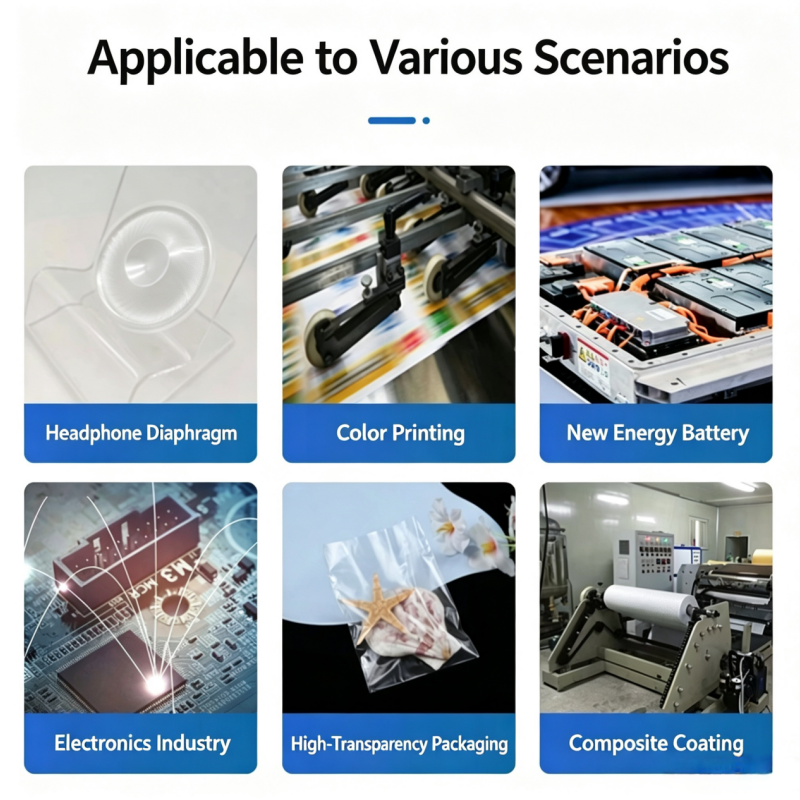
1. Motor & transformer insulation: Slot liners, phase insulation, layer insulation in generators, EV motors, dry-type transformers
2. Flexible printed circuits (FPC) - Stiffeners, coverlay, carrier tapes, mask films for soldering/reflow processes
3. Industrial tapes & labels–High-temperature masking tape base, durable label facestock, wire harness wrapping
4. Electronic components–Membrane switches, touch sensor substrates, battery cell insulation (pouch cell tabs)
5. Optical & display–Transparent windows for sensors/cameras, flexible display backplanes (low-haze grade), protective covers for LED modules
6. Solar & renewable energy–Backsheet inner layer, junction box insulation, cable jacketing reinforcement
7. Packaging–High-barrier lidding films, retort pouch structures, medical device packaging requiring steam sterilization.
When to Choose PEN over PET or PI:
1. When PET fails due to temperature (>130°C) or dimensional instability – e.g., automotive under-hood electronics, reflow soldering processes, high-power LED assemblies.
2. When transparency is required alongside moderate heat resistance – e.g., sensor windows, optical alignment fixtures, see-through insulating layers. PET cannot survive the heat; PI is opaque; CPI is too expensive.
3. When long-term reliability in humid or chemically aggressive environments is critical – e.g., marine equipment, outdoor telecom cabinets, battery pack enclosures. PET hydrolyzes; PI absorbs moisture and may degrade insulation.
4. When budget constraints rule out PI but performance demands exceed PET – e.g., mass-produced consumer electronics, mid-range industrial motors, solar junction boxes.
-

Silicone Oil Coated Polyester Release Film for ...
-

Low Adhesion Single Side Polypropylene Film Bat...
-

Energy Saving Aluminium Foil Insulation Mirror ...
-

High Class Insulation JP Formable Polyimide fil...
-

Ultra-thin Matte Black Graphite PET Film Tape E...
-

Anti Scratched Clear Polyethylene PE Protective...


